

How Often Should Lifting Equipment Be Inspected? A Practical LOLER Guide
- LOLER and PUWER: The Legal Framework for Lifting Equipment Inspections
- What Is a Thorough Examination Under LOLER?
- Who Counts as a Competent Person?
- Types of Checks: Pre-use, In-service Inspection, Maintenance and LOLER Thorough Examination
- Typical Statutory LOLER Thorough Examination Intervals
- How Often Should Different Types of Lifting Equipment Be Checked in Practice?
- Written Examination Schemes: When and Why Intervals Change
- Consequences of Getting Inspection Intervals Wrong
- Managing LOLER Inspections in a Real Workplace
- How Evolve Training Can Support Safe Lifting Operations
- Frequently Asked Questions
Getting inspection intervals wrong is one of the most common failings in lifting operations across the UK. Poorly inspected cranes, forklift trucks, hoists and lifting accessories remain a frequent cause of dropped loads, serious injuries and fatalities – particularly in high-risk sectors like oil and gas, construction, marine and utilities.
The inspection frequency for lifting equipment in the UK is governed by the Lifting Operations and Lifting Equipment Regulations 1998 (LOLER), working alongside the Provision and Use of Work Equipment Regulations 1998 (PUWER). Together, these lifting equipment regulations set the legal framework for keeping people safe around lifting gear. LOLER aims to reduce lifting incidents by enforcing safety standards that every dutyholder must meet.
At Evolve Training, our in-house trainers regularly see confusion between routine inspection, maintenance and statutory thorough examination during practical courses. This article gives you a clear, non-legal guide to typical inspection intervals and the different types of checks your business needs. For definitive legal wording, always refer to current HSE publications.
LOLER and PUWER: The Legal Framework for Lifting Equipment Inspections
LOLER and PUWER work together to cover operations and lifting equipment in the UK. Understanding how they overlap helps you build a comprehensive compliance program.
- LOLER ensures that lifting operations are properly planned, supervised and carried out by competent people, and that lifting equipment undergoes appropriate thorough examination at set intervals. LOLER covers cranes, hoists, forklift trucks, mobile elevating work platforms and lifting accessories. It does not cover escalators or roller shutter doors.
- PUWER underpins general work equipment regulations, requiring suitable equipment selection, safe use and maintenance to keep machinery in efficient working order. If you want to understand more about PUWER assessments, Evolve’s PUWER Assessor Course explains how these regulations apply in practice.
- Most workplace lifting equipment falls under both sets of equipment regulations – LOLER for the lifting aspects, PUWER for general health and safety and maintenance.
LOLER mandates that lifting equipment is suitable and properly maintained for every task it performs, including lowering loads as well as raising them. The sections below explain how often equipment needs pre-use checks, in-service inspections, maintenance and LOLER thorough examinations under these regulations.
What Is a Thorough Examination Under LOLER?
A thorough examination is a detailed, systematic check of lifting equipment and its safety-critical parts, carried out by a competent person at prescribed intervals. It is not the same as a visual check or routine maintenance – it is a formal, statutory process.
The examination may involve functional tests, measurement of wear, and where necessary partial dismantling to detect defects or deterioration that could lead to dangerous situations. Thorough examinations include checks for safety-critical parts such as brakes, limit switches, structural members and load-bearing components. A thorough examination is also required after structural modifications or repairs.
The competent person undertaking the examination must produce a thorough examination report meeting LOLER Schedule 1 requirements, including: the date of examination, equipment details, any defects found, and the date the next thorough examination is due. Serious defects must be reported immediately to the dutyholder, and the equipment must be taken out of service until necessary repairs are completed. In certain cases, the examination report must also be sent to the relevant regulatory authorities.
Who Counts as a Competent Person?
Choosing the right competent person directly affects the quality of your LOLER inspections and your overall compliance posture. A competent person must conduct thorough examinations – there is no shortcut around this requirement.
A competent person is someone with sufficient practical and theoretical knowledge and experience to detect defects in lifting equipment and judge whether it is safe for continued service. They should also have enough independence and impartiality to make an objective assessment; the appropriate degree of independence depends on the circumstances. A competent person can establish a custom examination scheme based on risk assessment where the default intervals are not appropriate.
The competent person can be internal (an in-house lifting engineer with the right qualifications) or external (a specialist inspection body), provided independence is maintained. If you want supervisors and managers to understand the LOLER regulations more fully – including what to ask of competent persons and how to interpret their reports – Evolve Training offers a dedicated LOLER Awareness course within its lifting operations programme.
Types of Checks: Pre-use, In-service Inspection, Maintenance and LOLER Thorough Examination
The word “inspection” is often used loosely, which creates confusion. In practice, there are four distinct levels of checking, each with a different purpose and frequency.
- Check Type: Pre-use / pre-shift check; Who Does It: Operator; Typical Frequency: Before every use or shift; Purpose: Spot obvious damage, leaks, faulty controls, missing guards, illegible safe working loads markings
- Check Type: In-service inspection; Who Does It: Suitably trained person; Typical Frequency: Risk-based and manufacturer-led; Purpose: Structured checks to identify wear and deterioration between thorough examinations
- Check Type: Maintenance; Who Does It: Maintenance team; Typical Frequency: Per manufacturer schedule; Purpose: Servicing, adjustment, repair, parts replacement to keep equipment reliable
- Check Type: LOLER thorough examination; Who Does It: Competent person; Typical Frequency: 6 or 12 months (or per written scheme); Purpose: Formal statutory examination, documented in a written report
- Check Type: Routine pre-use checks are required before operating lifting equipment – they are your first line of defence. Lifting equipment must be marked with safe working loads so operators can verify correct use during these checks. In-service inspections sit between daily checks and formal examinations, helping to identify potential issues before they escalate.
Typical Statutory LOLER Thorough Examination Intervals
So how often should lifting equipment be inspected under LOLER? The default statutory intervals – which apply unless a written examination scheme sets different timescales – are as follows. Always verify these against current HSE guidance:
- Every 6 months: lifting equipment used to lift people (e.g. man-riding baskets, mobile elevating work platforms, a platform lift installed in a workplace, passenger lifts used by employees)
- Every 6 months: all lifting accessories (chains, wire ropes, wire rope slings, shackles, eyebolts, hooks)
- Every 12 months: other lifting equipment used for goods only (overhead travelling cranes, gantry cranes, vehicle tail-lifts, counterbalance forklift trucks, pallet trucks with lifting mechanisms)
Equipment may require thorough examination before first use, particularly where safety depends on installation or assembly. Further examination may also be required after exceptional circumstances that could jeopardise safety, such as major modification, overload, collision or prolonged exposure to damaging conditions. Inspection intervals can vary depending on equipment usage and environmental conditions; a competent person can draw up a written examination scheme specifying different frequencies based on risk.
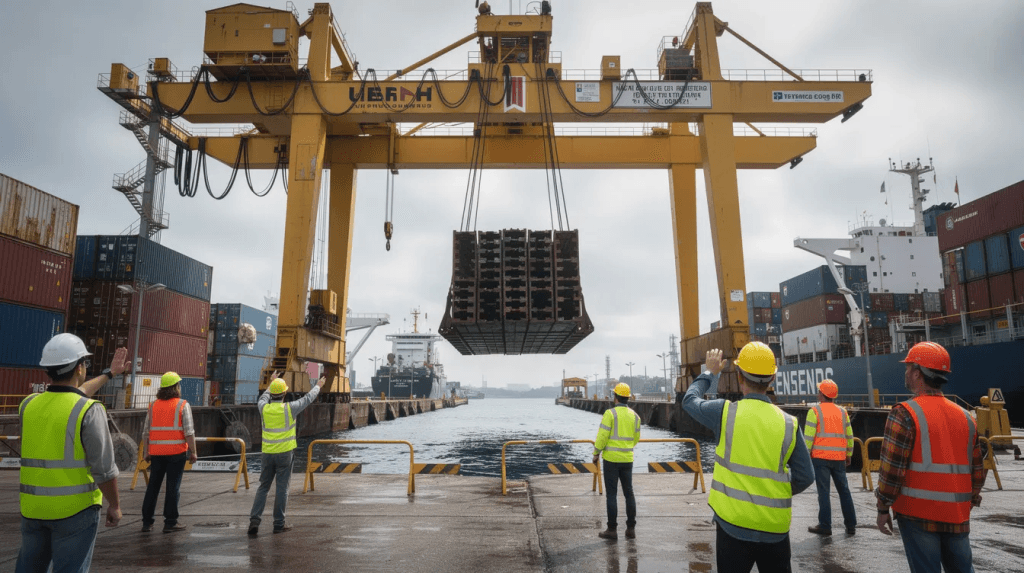
High-risk environments common around Aberdeen – offshore platforms, quaysides, fabrication yards – may justify more frequent LOLER inspections than the bare minimum, due to salt-laden air, heavy loads and intensive use.
How Often Should Different Types of Lifting Equipment Be Checked in Practice?
Beyond statutory thorough examinations, employers need to decide how often to run pre-use and in-service inspections for specific types of equipment. Here are some typical regimes (these are examples only – your own risk assessments, manufacturer instructions and competent person advice should guide your decisions):
- Overhead crane in a fabrication shop: pre-use operator check before each shift; weekly in-service inspections by the maintenance team; 12-monthly thorough examination (or more frequently under a scheme).
- Forklift truck lifting pallets: daily pre-use checks covering brakes, hydraulics, forks and mast; scheduled PUWER maintenance; 12-monthly thorough examination for the lifting mechanism.
- Lifting accessories (chain slings, shackles, webbing slings): lifting accessories include slings, shackles, and eyebolts. Visual check before every use; monthly recorded inspections (many sites use a colour-code tag system); 6-monthly thorough examination. Even accessories used only twice a year still need that 6-monthly examination – there is no usage-frequency exemption.
Equipment used to lift people and lifting accessories normally fall within the six-month thorough examination interval unless a competent person’s written scheme specifies otherwise. Severe service conditions, corrosive atmospheres, abrasive loads, outdoor storage and intensive use may justify more frequent checks or examinations.
Written Examination Schemes: When and Why Intervals Change
Rather than simply following the 6- and 12-month defaults, a competent person can draw up a written examination scheme tailored to your operations. This is particularly valuable for complex lifting operations.
The scheme specifies which items are to be thoroughly examined, what methods will be used, and the intervals between examinations for each item or group. For businesses running multiple cranes, davits, runway beams or offshore lifting systems, a scheme allows higher-risk essential components to be examined more frequently, while lower-risk items follow a different schedule.
A written scheme cannot be used to justify unsafe gaps – it must be based on genuine risk assessment, real operating conditions and manufacturer information. Evolve Training’s LOLER Planner Course helps appointed persons understand how these schemes work in practice. Managers should ensure the examination scheme remains appropriate and arrange a review when equipment, operating conditions or risk materially change.
Consequences of Getting Inspection Intervals Wrong
Skipping or delaying thorough examinations is not an administrative oversight – it is a serious legal and moral risk that can affect every level of your organisation.
- Financial and operational consequences: serious health and safety breaches can lead to enforcement notices, prosecution, substantial fines and work being stopped until risks are controlled.
- Criminal liability: directors, senior managers and responsible persons can face criminal charges and prosecution. Non-compliance can lead to criminal prosecution and imprisonment in the most serious cases where failures in lifting equipment regulations contribute to injury or fatality.
- Reputational damage: a well-publicised lifting accident can significantly impact long-term business success. It can damage a company’s reputation, make recruitment harder, affect tender success and increase insurance premiums. Non-compliance can result in business operational disruptions and license suspensions.
- Commercial consequences: weak inspection records can affect client assurance, tendering, insurance discussions and the organisation’s ability to demonstrate effective control of lifting risks.
Businesses reduce risks significantly by treating regular inspections and thorough examinations as essential compliance requirements rather than tick-box exercises.
Managing LOLER Inspections in a Real Workplace
A well-organised inspection regime ensures thorough examinations are never missed and equipment stays safe between those dates. Here is how to stay ahead of your compliance activities:
- Create a lifting equipment register listing each item, its unique ID, location, safe working loads, last inspection date, next LOLER due date, and any applicable examination scheme reference.
- Use planning tools – calendar reminders, maintenance software or spreadsheets – so managers receive prompts well ahead of LOLER inspections, allowing time to book a competent person and avoid unplanned downtime.
- Train your people. Operators, supervisors and appointed persons need to understand their role in pre-use checks, defect reporting and tagging unsafe equipment out of service. Evolve Training offers lifting operations courses including Rigging & Lifting, forklift and working at height training that cover these practical skills.
- Keep robust records. Retention depends on the type of equipment and report: records for lifting accessories are generally kept for at least two years, while other thorough-examination reports are kept until the next report is made or for two years, whichever is later. Check current HSE guidance for the exact requirement that applies. Store reports securely so they are easy to retrieve during inspections, audits or investigations. Inspection records should be protected from unauthorised changes to maintain a clear audit trail.
How Evolve Training Can Support Safe Lifting Operations
Evolve Training is a practical partner for Aberdeen and North-east Scotland businesses that need their teams to be well informed about LOLER inspection requirements and legal compliance. Our experienced in-house trainers use real-life examples from local industries – oil and gas, marine, construction, utilities – to explain how to set sensible inspection frequencies and work effectively with competent persons.
We deliver accredited courses relevant to lifting equipment and lifting operations, including LOLER awareness and planning, Banksman / Slinger, crane and forklift operator training, working at height, manual handling, IOSH and NEBOSH qualifications. Training can help operators, supervisors and managers understand their responsibilities and apply safer systems of work in their own workplaces.
Explore our full range of lifting operations courses to find the right option for your team. We publish course dates, provide on-site parking at our Dyce centre, and offer training at customer premises for suitable requirements.
Frequently Asked Questions
These FAQs cover common queries that go beyond the main inspection interval guidance above. They are aimed at supervisors and managers implementing LOLER on site. For definitive legal detail, always verify against current HSE publications.