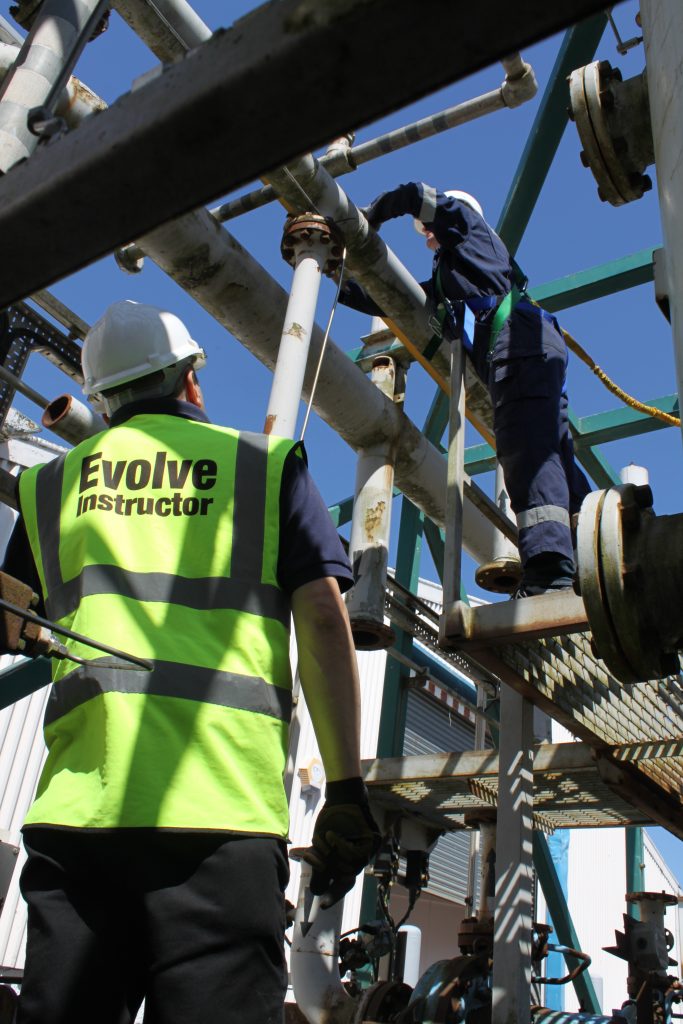


What You Need To Know About Working At Height Safety
- What is Working At Height?
- What Do The Work at Height Regulations 2005 Say?
- Risk Assessment and Planning Work: The Heart of Safety at Height
- The Hierarchy of Control Measures
- Ladders And Stepladders: When They Make Sense And When They Don't
- Working Platforms, Elevated Work Platforms And Mobile Elevated Work Platforms (MEWPs)
- Fragile Surfaces, Falling Objects, And Other Critical Hazards
- Weather Conditions And Overhead Power Lines
- Training, Inspection And Personal Protection Equipment
- Why Choose Evolve Training?
- Summary
Working at height remains one of the most critical health and safety issues in the United Kingdom. The latest data from the HSE shows that falls from height remained the most common type of fatal accident at work in Great Britain, with 35 deaths in 2024/25, accounting for more than a quarter of all occupational deaths.
This explains why working at height requires such a focus on planning, training, inspection and the correct choice of equipment. When we talk about what work at height safety is, we are not just talking about roofs, high scaffolding or lifting platforms. In the UK legal context, the issue involves any activity in which a person could suffer a fall capable of causing personal injury.
In other words, working at height does not depend on how many metres high it is; it depends on the actual risk of falling and the possible consequences. This is precisely why businesses, employers, supervisors and workers need to understand not only the legal definition, but also the control measures that make the activity safe and compliant with the Work at Height Regulations 2005.
What is Working At Height?
According to the definition used by the HSE, working at height is any work carried out in a location where, if precautions were not in place, someone could fall a distance likely to cause personal injury. This includes work above floor level, near an open edge, on or near fragile surfaces, and even situations where someone could fall from ground level to a lower level, such as a gap in the floor or a hole in the ground.
The rule also makes it clear that walking up and down a permanent staircase in a building is not, in itself, classified as working at height. This point is important because many companies still associate working at height only with very high tasks.
The risk can arise in simple maintenance, changing light fixtures, accessing a roof, using ladders and stepladders, working platforms, or working near unprotected openings. In a well-managed workplace, the right question is not ‘is this high enough?’, but rather ‘is there a risk of falls and injuries if something goes wrong?’.
What Do The Work at Height Regulations 2005 Say?
The Work at Height Regulations 2005 exist to prevent death and injury caused by falls. These height regulations apply to employers and also to anyone who controls work activities at height, such as facilities managers, building owners or contractors. The law requires that work be properly planned, supervised and carried out by competent persons using appropriate work equipment.
This means that legal obligations go far beyond simply providing a harness or ladder. Employers have a duty to avoid work at height where possible, carry out risk assessments, select suitable equipment, ensure that workers are properly trained, and check that equipment has been properly inspected and maintained. They also need to control risks related to fragile surfaces, falling objects, access to the site, rescue and environmental conditions.
For employees and other workers, the logic is complementary. Follow procedures, use safety equipment correctly, cooperate with the safety system, and report defects, changes in conditions, and potential hazards before an incident occurs. In a mature health and safety environment, legal compliance is not just paperwork; it is the basis for reducing real risk.
Risk Assessment and Planning Work: The Heart of Safety at Height
If there is one thing that separates a controlled task from a dangerous operation, it is risk assessment. Working at height must be thought through before starting, and this includes identifying hazards, deciding on control measures, defining appropriate safety measures, and reviewing the plan whenever the task, location, weather, or method changes.
A good risk assessment does not just look at where the person will be. It needs to consider access, exit, ground stability, risk of falling objects, proximity to overhead power lines, vehicle interference, public exposure, type of equipment used, duration of the activity, and the actual capacity of the workers involved.
When the risk assessment shows that there are significant risks, the work should not continue in the same way just because it has always been done that way; it needs to be redesigned with adequate control measures or even alternative methods. This is where the true value of planning work comes in.
A safe task does not begin the moment a person climbs onto a platform. It begins earlier, when the company chooses the safest method, defines the right equipment, assesses who will be involved, establishes supervision, checks the condition of resources, and prepares emergency responses. Working at height must be done in an organised and safe manner, not improvised.
The Hierarchy of Control Measures
The HSE works with a very clear logic for preventing falls. First, working at height should be avoided whenever reasonably practicable. If the work cannot be done at ground level, the next step is to prevent falls by using existing safe workplaces or working platforms and collective barriers.
Only then do other measures come into play to reduce the distance and consequences of a fall. This hierarchy is important because not all protective equipment offers the same level of protection. Collective systems, such as guard rails, protected platforms and toe boards, protect more than one person at a time and are less dependent on individual behaviour.
Individual protection systems, such as harnesses and fall arrest systems, are essential in many scenarios, but require correct selection, proper anchoring, training, and a rescue plan. The golden rule remains to first try to eliminate the risk, then control it with collective means, and only then resort to what depends directly on the user.
Ladders And Stepladders: When They Make Sense And When They Don’t
One of the most common myths about working at height is that ladders and stepladders have been banned. However, they are not prohibited. The point is that they should be used proportionately, when the risk assessment shows that equipment with greater protection is not justified for that task.
This usually means low-risk, short-term work and stable conditions of use. Even so, it is not enough to have a ladder available. It needs to be the right one for the job, be in good condition, be supported on firm and stable ground, and be used by someone with appropriate training.
The user must be able to keep both feet and an additional point of support when necessary, without turning the ladder into a makeshift solution for a job that would require different equipment. The HSE itself advises considering alternative equipment if the operator has to remain on the ladder or stepladder for more than 30 minutes at a time.
Working Platforms, Elevated Work Platforms And Mobile Elevated Work Platforms (MEWPs)
For many activities, the safest method is not a ladder, but rather the use of working platforms or elevated work platforms. These include towers, suitable scaffolding, and mobile elevated work platforms, such as scissor lifts and cherry pickers.
These resources usually offer a more stable working base, better access, collective protection, and better positioning for the task. But lifting platforms also have their own hazards. The main dangers with MEWPs arise more from the operation and use of the machine than from simply moving around the site.
Among the most relevant problems are tipping, entrapment, collision, use on uncontrolled routes, improper approach to electrical power, and lack of separation between vehicles and pedestrians. Therefore, choosing mobile elevated work platforms does not eliminate the risk; it only changes the type of risk that needs to be managed with safety precautions, inspection, and operational competence.
Fragile Surfaces, Falling Objects, And Other Critical Hazards
Falls through fragile surfaces, especially fibre cement roofs and rooflights, account for a significant proportion of fatalities from falls in construction. The guidance is that work on or near these surfaces requires a safe working system, and roofs should be treated as fragile until a competent person confirms otherwise.
Another common hazard is falling objects. In many tasks, the risk falls not only on those at height, but also on those circulating below. Tools, components, materials and debris can cause serious personal injury even when the worker’s fall is prevented. Therefore, toe boards, exclusion zones, good site tidiness, material containment and the correct choice of work equipment are a real part of control measures, not an optional detail.
Weather Conditions And Overhead Power Lines
Weather conditions also factor into planning. Except for emergency services responding to actual emergencies, work at height should only take place when conditions are safe. In roof work, rain, ice, frost, and strong winds increase the risk of slipping, loss of balance, and operational failure. In other words, productivity should never come before safety.
Overhead power lines require special attention because direct contact is not always necessary for an accident to occur. Excessive proximity can cause electric arcing, so begin planning by identifying whether there are any overhead lines inside, next to, or on the way to the work area.
It is also advisable to assume that the line is live until confirmed otherwise and to seek guidance from the network operator when in doubt. This is a risk that is often underestimated in maintenance, construction and the use of platforms.
Training, Inspection And Personal Protection Equipment
No health and safety system works well if people are not properly trained. Those who plan, supervise and perform work at height must have the right level of competence for the task at hand. This applies to the use of ladders, platforms, anchoring systems, inspections and also to emergency response.
It is also not enough to provide personal protective equipment or other safety equipment without inspection. The equipment must be selected for the actual risk, inspected before use where applicable, kept in a safe condition and used within the manufacturer’s and task’s limits.
In scenarios where falls cannot be completely avoided, fall arrest systems may be necessary, but they only make sense when accompanied by adequate anchoring, training, supervision and planned rescue.
Why Choose Evolve Training?
For companies and professionals who need to transform legal requirements into safe practice, Evolve Training is aligned with what the British market demands today. The company offers working at height courses combining theory and practical demonstrations, covering the use of access equipment, fall protection, risk assessments, legal responsibilities and control measures aimed at compliance with the Work at Height Regulations 2005.
Evolve’s Working at Height course closely adheres to what a responsible employer expects from a solid programme: current legislation, hierarchy of risk, work platforms and MEWPs, anchor selection, fall arrest systems, work restraint, personal protection equipment, ladders and stepladders, working on roofs, equipment inspection, fragile surfaces, rescue overview and risk assessment principles.
In addition, its track record since 1993 and its history as a training and safety support provider reinforce its credibility for organisations seeking more than just superficial training.
Summary
In the United Kingdom, working at height is not just a matter of physical height, but of actual exposure to the risk of falls and personal injury. The Work at Height Regulations 2005 require that work be properly planned, carried out by competent persons and supported by appropriate work equipment, inspection and adequate training.
This means starting at ground level whenever possible, applying a thorough risk assessment, choosing suitable equipment, controlling fragile surfaces, falling objects, weather conditions and overhead power lines, and ensuring that each task is conducted as safely as possible.
When businesses treat safety at height as a central part of their operation, rather than a bureaucratic obligation, the result is better compliance, fewer incidents and a much safer workplace.